
BDSM Negotiation: 8 Honest Questions to Ask Before a Scene
A practical guide to BDSM negotiation: why it matters, eight honest questions to ask before any scene, and how to keep the conversation relaxed.

The best scenes start long before anyone touches anyone. BDSM negotiation is the conversation where partners agree on what will happen, what will not, and how they will look after each other. It sounds formal, but it is really just honest planning between adults who want the same thing: a great experience that leaves everyone feeling good.
This guide explains why BDSM negotiation matters, gives you eight honest questions to cover, and shares tips to keep the conversation relaxed rather than clinical.
Everything here is written for consenting adults 18 and older.
Want to see how other people negotiate? Drop into our moderated BDSM chat room and ask.
Table of Contents
Why BDSM Negotiation Matters
Kink often involves intensity, restraint, or power. Those things are fun precisely because they are agreed in advance. BDSM negotiation is how that agreement happens. Without it, partners are guessing, and guessing is how people get hurt.
Negotiation also builds anticipation. Talking about what you want, in detail, is often part of the fun. Many experienced players say the negotiation is where the scene really begins.
Finally, BDSM negotiation creates informed consent. You cannot meaningfully agree to something you do not understand. Talking it through makes sure everyone knows what they are saying yes to.

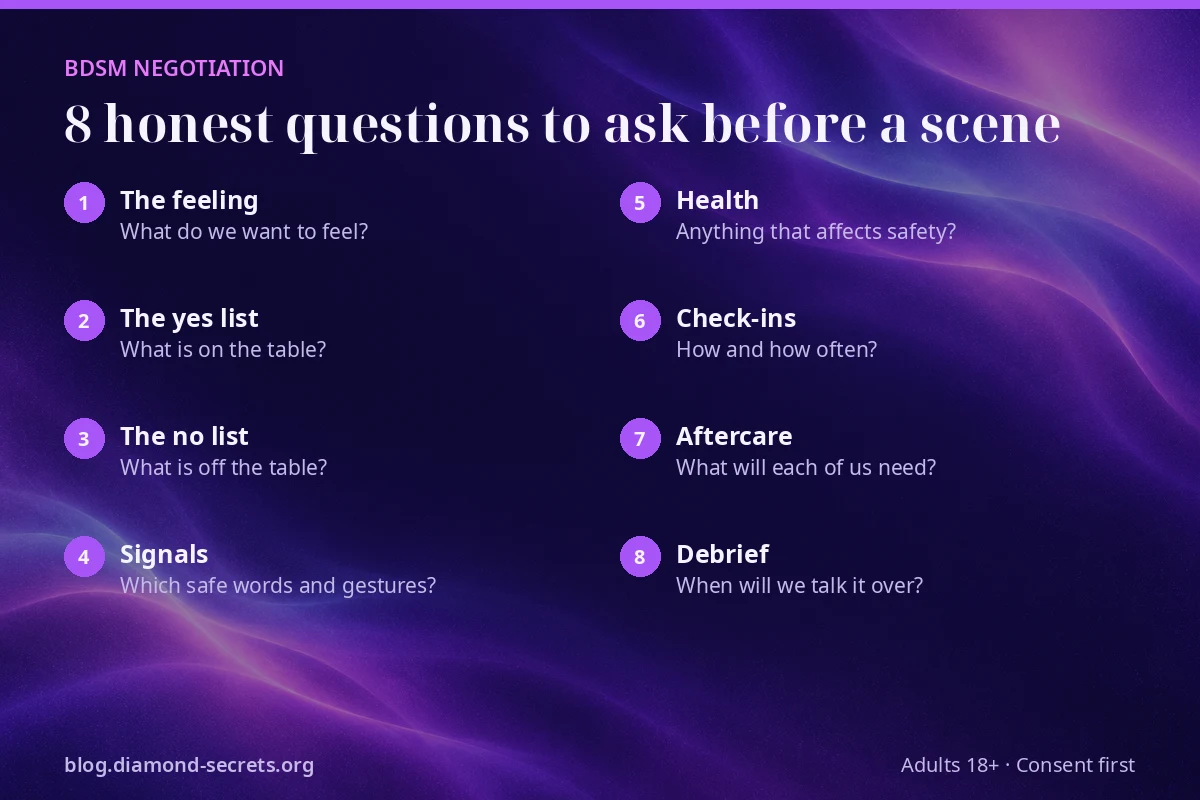
8 Honest Questions for BDSM Negotiation
1. What are we hoping to feel?
Start with the goal, not the activity list. Do you want to feel cared for, overwhelmed, playful, controlled, powerful? Knowing the emotional target helps you choose activities that hit it.
2. What is on the table?
List the specific activities you both want to include. Be concrete. “Some light spanking with a hand, no implements” is far clearer than “a bit of impact.”
3. What is off the table?
Cover hard limits, which are never okay, and soft limits, which might be okay under certain conditions. Include words, names, or roleplay themes that are off-limits too. A shared yes, no, maybe list makes this part fast.
4. What are our safe words and signals?
Agree on safe words and a nonverbal signal. Confirm what each one means and what will happen when it is used.
5. Is there anything about health or history I should know?
This part of BDSM negotiation covers physical and emotional safety. Ask about injuries, joint problems, medical conditions, medications, allergies, and anything that might trigger a strong reaction. Share sexual health information if relevant. Nobody has to share their full history, but anything that affects safety should be on the table.
6. How will we check in?
Decide how often the person in control will check in, and how. A quick “color?” is common. Some people prefer a squeeze of the hand or a specific question.
7. What do we each need afterward?
Plan aftercare before you play, when everyone is thinking clearly. Ask about touch, words, food, space, and whether a next-day check-in would help.
8. How will we talk about it later?
Agree to debrief. A quick conversation the next day about what worked and what to change makes the next scene even better.
A Sample BDSM Negotiation Conversation
It helps to hear how this sounds in real life. Here is a short, relaxed example between two partners planning a light scene. Notice how ordinary it is.
A: So for Friday, what are you in the mood for?
B: I’d like to feel looked after but a bit teased. Maybe being told what to do, and some light spanking with your hand.
A: I’d love that. Anything off the table?
B: No implements this time, and no name-calling. My shoulder is still sore, so nothing with my arms above my head.
A: Got it. Traffic lights as usual? And if you can’t talk, drop the keys.
B: Yes. And afterward I’ll want the blanket and that awful show we both love.
A: Deal. I’ll check in with you Saturday too.
That took two minutes, and it covered the goal, the activities, limits, a health issue, signals, and aftercare. Good BDSM negotiation does not have to be long. It has to be clear.
Questions Each Role Can Ask
Negotiation is a two-way street. Both partners should ask questions, not just answer them.
If you are leading the scene
- “Is there anything you are nervous about?”
- “How will I know if you are enjoying it versus enduring it?”
- “What should I do if you go quiet?”
If you are following
- “What do you enjoy most about this kind of scene?”
- “Is there anything you need from me during it?”
- “What do you need afterward?”
When both people ask, BDSM negotiation becomes a real exchange rather than a list of demands.
How to Keep BDSM Negotiation Relaxed
Negotiation does not have to feel like a job interview. A few tips help:
- Do it outside the bedroom. Talk over coffee, on a walk, or in chat. You will both think more clearly.
- Do it sober. Consent given while drunk or high is not reliable.
- Use a checklist. Printed or digital lists remove the awkwardness of coming up with everything from scratch.
- Be curious, not defensive. If your partner says no to something you love, ask what about it does not appeal. You might learn something.
- Keep it ongoing. BDSM negotiation is not a one-time contract. Revisit it as you learn more about each other.
BDSM Negotiation With a New Partner
With someone new, take more time and play smaller. A first scene should be simple and short, with frequent check-ins. Tell a trusted friend where you will be and when to expect to hear from you, a practice known as a safe call.
Be wary of anyone who wants to skip BDSM negotiation, rushes you, or reacts badly to your limits. Those behaviors are on our list of BDSM red flags for a reason.
BDSM Negotiation in Long-Term Relationships
Long-term partners sometimes stop negotiating because they think they know each other. But moods change, bodies change, and interests grow. A quick pre-scene check, such as “anything different tonight?”, keeps things fresh and safe.
It is also worth doing a bigger conversation every few months. Revisit your limits list, talk about what you want to try next, and drop what no longer works.
Negotiating Online and Text Scenes
BDSM negotiation matters in chat too. Before a text roleplay, agree on the theme, limits, safe words, and how to step out of character. Use out-of-character markers like “OOC” for check-ins.
Our BDSM chat etiquette guide covers this in detail, and our consent in online roleplay guide explains how to handle scenes that drift. If you want to practice, the regulars in our BDSM room are used to negotiating in text.
What Consent Should Look Like
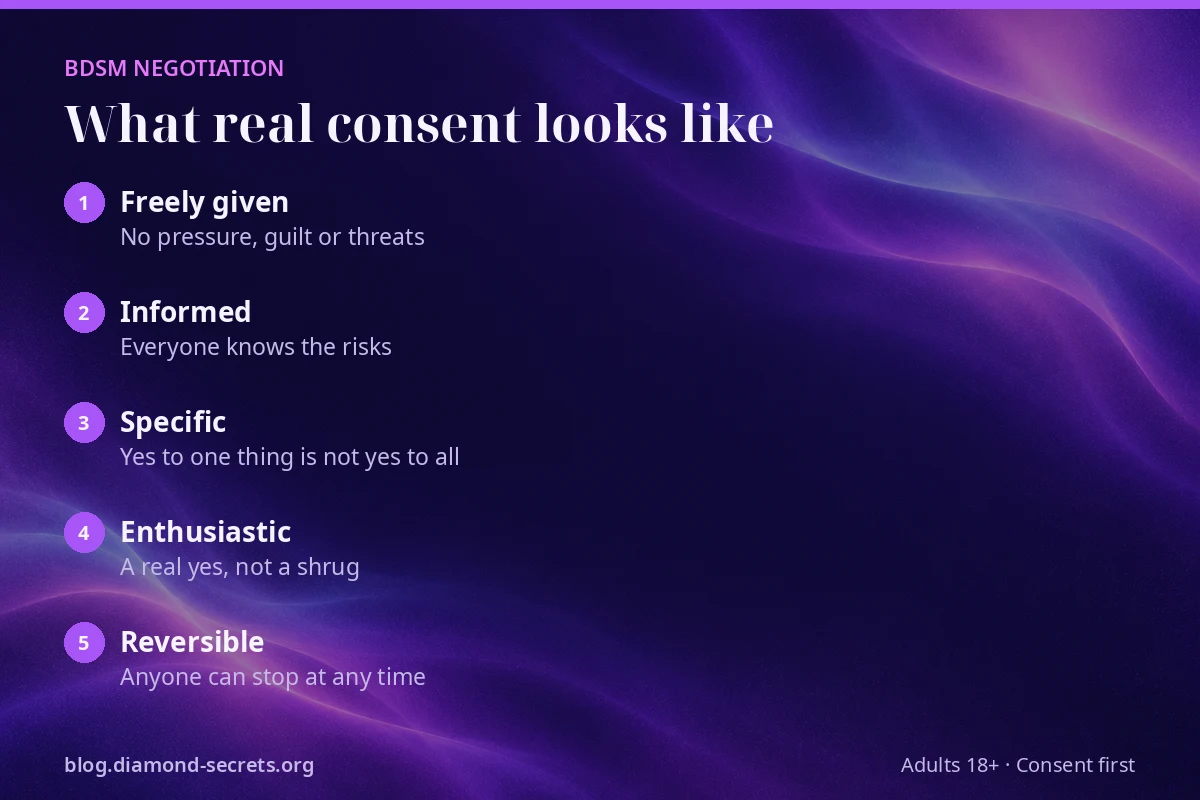
Every BDSM negotiation should produce consent that is:
- Freely given. No pressure, guilt, or threats.
- Informed. Everyone understands the activities and risks.
- Specific. Yes to one thing is not yes to everything.
- Enthusiastic. Look for a real yes, not a reluctant shrug.
- Reversible. Anyone can withdraw consent at any time.
Planned Parenthood’s overview of sexual consent is a useful refresher that applies directly to kink.
A Simple BDSM Negotiation Template
If you want something you can copy and paste, try this:
- Goal: how we want the scene to feel.
- Yes list: activities we agree to.
- No list: hard limits and words to avoid.
- Maybe list: soft limits and the conditions for them.
- Signals: safe words and nonverbal signals.
- Health: anything that affects safety.
- Check-ins: how and how often.
- Aftercare: what each person needs.
- Debrief: when we will talk about it.
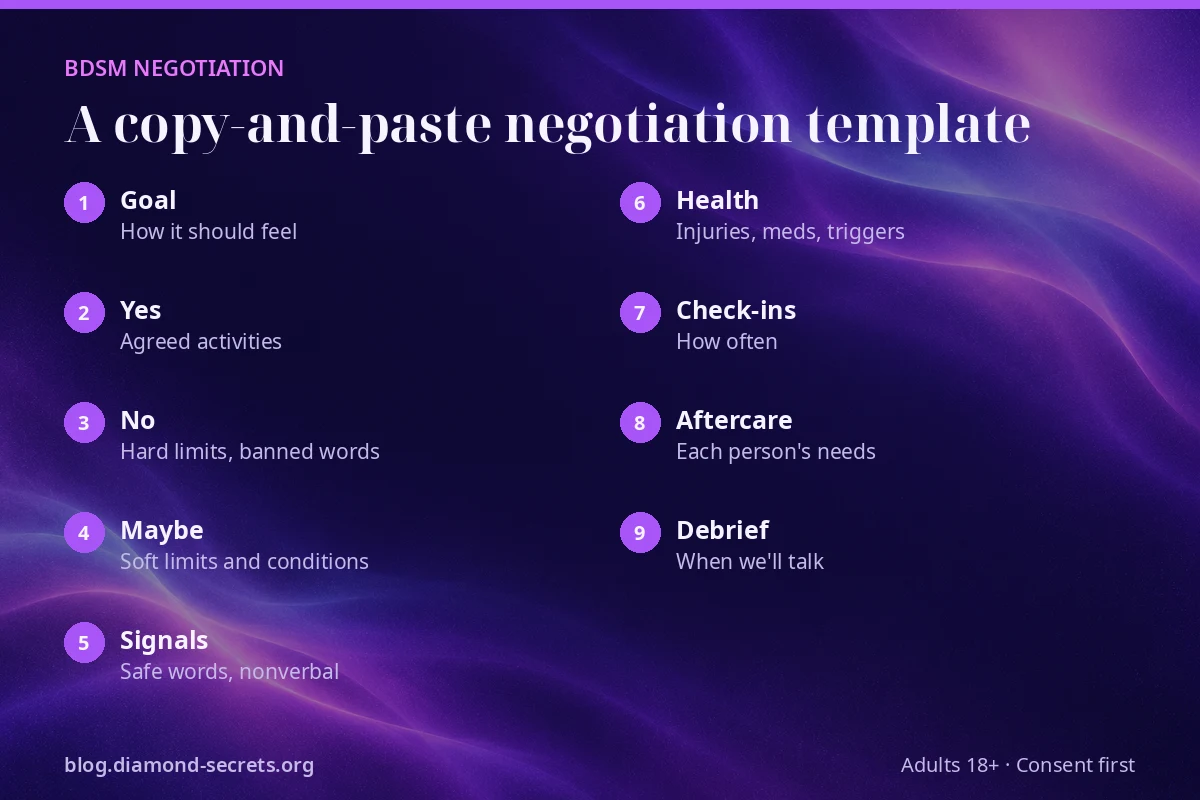
Save it in your notes app and fill it in together. After a few scenes, BDSM negotiation with this template becomes second nature, and you will find yourselves covering everything in a few minutes.
Common BDSM Negotiation Mistakes
Even experienced players slip up. These are the BDSM negotiation mistakes that cause the most trouble, and how to avoid them.
- Being vague. “Some rough stuff” means different things to different people. Name specific activities and intensities.
- Negotiating in the moment. Talking in bed, already aroused, is not the time to agree on new limits. Excitement makes everyone say yes too quickly.
- Only one person asking questions. If one partner sets the agenda and the other just agrees, important needs get missed.
- Forgetting the emotional side. Physical limits are easy to list. Emotional ones, like words that sting or themes tied to past hurts, matter just as much.
- Assuming last time’s agreement still stands. A quick refresh before each scene catches changes in mood, health, or stress.
- Treating the plan as a contract to complete. Agreeing to something is not an obligation to do it. Anyone can stop, even if the plan said otherwise.
Negotiating When You Are Nervous
If talking about desires makes you blush or freeze, you are not alone. Try writing your answers first and swapping notes. Use a checklist so you only need to tick boxes. Or start with the easy topics, like aftercare and safe words, before moving to activities. BDSM negotiation gets easier every time you do it, and your partner is probably just as nervous as you are.
Frequently Asked Questions
Can we change the plan during a scene?
You can always do less. Adding new activities mid-scene is risky because the person in a submissive headspace may not be able to consent clearly. Save new ideas for the next negotiation.
Does negotiation kill spontaneity?
Not really. Once the boundaries are clear, there is more room to improvise inside them.
What if my partner does not want to negotiate?
That is a significant concern. Someone who refuses to discuss limits is not ready to play safely.
Talk First, Play Better
BDSM negotiation is simply caring enough to ask. Cover the eight questions, write down what you agree, and keep the conversation going. The result is play that feels safer, more connected, and more exciting.
New to kink? Start with our BDSM for beginners guide, or chat with our community about how they negotiate.

PhoenixJenn (aka Symphony) is the founder of Diamond Secrets — the 18+ chat community she built from scratch because the internet needed a place that actually felt worth staying in. Part platform builder, part community guardian, part music obsessive, she handles everything from tech and design to cyber safety and community culture, which means no two days look the same.
She’s been building online communities for years and genuinely cares about getting it right — which is why Diamond Secrets keeps growing while other chat sites quietly fade away. Safety is baked in from the start here, not bolted on as an afterthought, and the warm atmosphere isn’t an accident either. That’s all her.
If Diamond Secrets feels like a hidden gem worth telling your friends about, that’s entirely on purpose.