
BDSM for Beginners: 9 Simple Steps to Explore Kink Safely
A calm, practical guide to BDSM for beginners: what it is, what it is not, and nine simple steps to explore kink with consent, care and confidence.

Curiosity about kink is far more common than most people think. If you have been wondering where to start, this guide to BDSM for beginners is for you. It skips the hype and the shock value and focuses on what actually matters: understanding the basics, talking honestly, and exploring at a pace that feels good.
You do not need special gear, a partner who already knows everything, or a dramatic new identity. You need curiosity, communication, and a few habits that keep everyone safe. That is what the nine steps below are about.
Everything here is written for consenting adults 18 and older.
Want to talk it through with people who get it? Visit our moderated BDSM chat room and ask your questions without judgment.
Table of Contents
What BDSM for Beginners Really Means
BDSM is an umbrella term. The letters cover three overlapping pairs: bondage and discipline, dominance and submission, and sadism and masochism. Most people are drawn to one or two corners of that map, not all of it.
For beginners, BDSM is less about any single activity and more about a shared agreement. Two or more adults agree to play with power, sensation, or control, inside limits they have set together. The agreement is what turns something that could be harmful into something that is consensual, intentional, and often deeply connecting.
That is why every good resource on BDSM for beginners starts with talking, not toys. The conversation is the foundation everything else rests on.
What BDSM is not
- It is not abuse. Abuse removes choice. BDSM depends on it. Anyone who uses “it’s just kink” to excuse ignoring a no is not practicing BDSM.
- It is not one look. Leather and dungeons are one aesthetic. Plenty of kink happens in ordinary bedrooms between people in sweatpants.
- It is not a sign something is wrong with you. Research summarized by groups like the Kinsey Institute has found kink interests are widespread among healthy adults.

9 Simple Steps: BDSM for Beginners
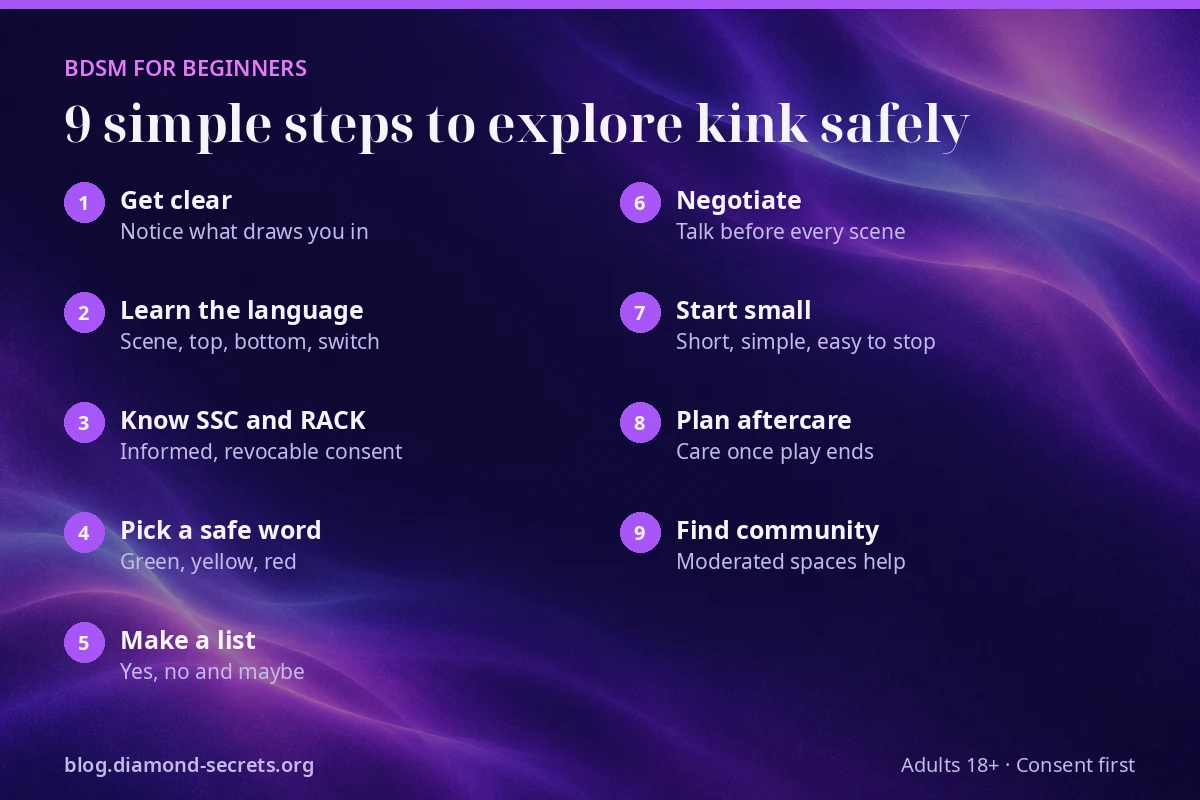
1. Get clear on what draws you in
Before you talk to anyone else, spend some time with your own curiosity. Is it the feeling of giving up control? Taking it? A particular sensation? The trust involved? The roleplay? Write a few notes. You do not have to label yourself yet, but knowing what pulls at you makes every later conversation easier.
2. Learn the language
Kink has a vocabulary, and knowing it helps you ask for what you want. Terms like scene, top, bottom, switch, limits, and aftercare come up constantly. Our guide to BDSM terms every beginner should know is a good place to start.
3. Understand consent frameworks
Two frameworks show up in almost every discussion of BDSM for beginners. SSC stands for safe, sane, and consensual. RACK stands for risk-aware consensual kink, which admits that no activity is perfectly safe and asks everyone to understand the risks they accept. Either way, consent must be informed, freely given, specific, and revocable at any time.
4. Choose a safe word before anything else
A safe word is a clear signal that stops or slows play, no questions asked. Many people use the traffic light system: green for keep going, yellow for slow down or check in, red for stop. Read our full guide to safe words and signal systems, including nonverbal options for when speaking is not possible.
5. Make a yes, no, maybe list
A yes/no/maybe list is one of the most useful tools in BDSM for beginners. You list activities and mark each one as something you want, something you will never do, or something you might try under the right conditions. It turns a vague, awkward talk into a concrete one. Our guide to hard and soft limits walks you through building one.
6. Negotiate every scene
Negotiation is simply the conversation before play. What are we doing? What is off the table tonight? How will we check in? What will we need afterward? It can take five minutes or an hour. Our BDSM negotiation guide lists the questions worth asking.
7. Start slow and small
The best first experiences are short, simple, and easy to stop. Light sensation, simple restraint with something easy to undo, or a power dynamic that lives mostly in words are all common starting points. You can always do more next time. You cannot undo going too far too fast.
8. Plan for aftercare
Aftercare is the care you give each other once play ends: water, a blanket, quiet, reassurance, or a debrief. Intense experiences can leave people emotional, tired, or a little shaky, sometimes hours or days later. Read more in our BDSM aftercare guide.
9. Find community and keep learning
Kink communities, online and in person, are a great resource for BDSM for beginners, and they are full of people happy to share what they have learned. Moderated spaces are especially good for beginners because rules and staff keep conversations respectful. Our BDSM room is a judgment-free place to ask the questions you are not ready to ask anyone else.
Roles You Might Explore
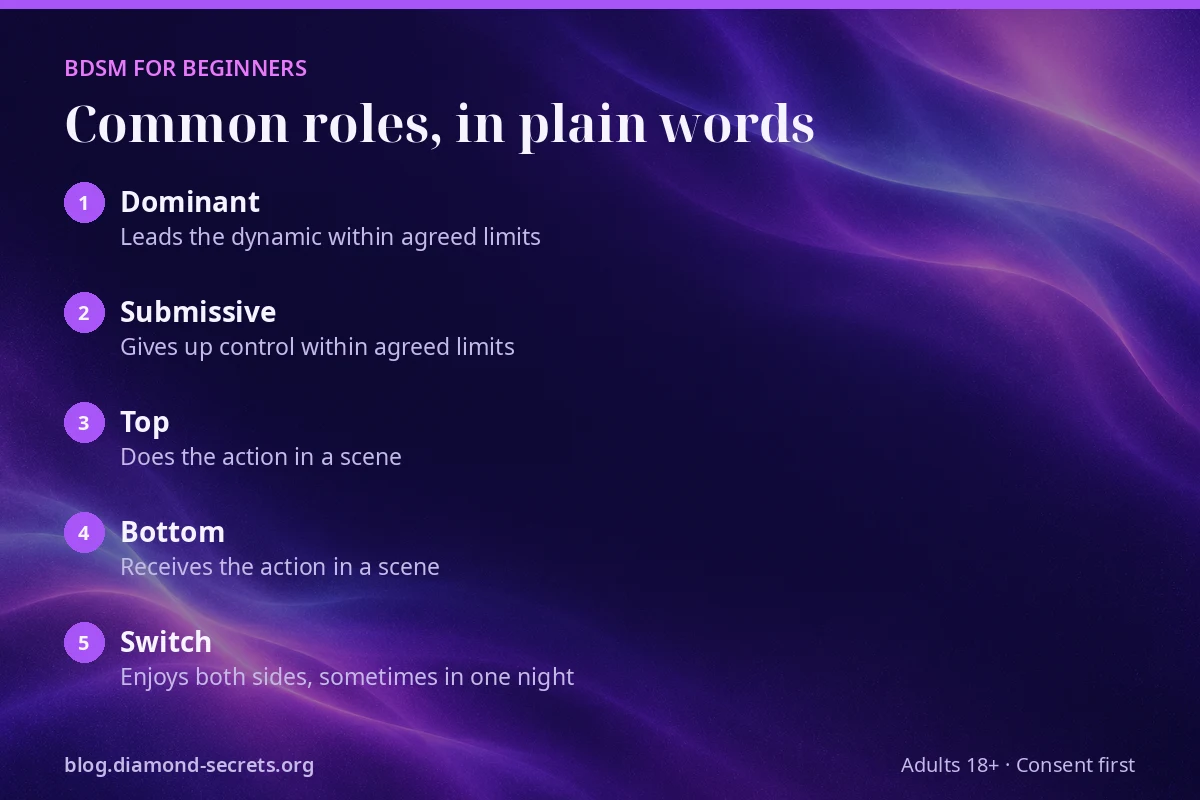
One of the first questions in BDSM for beginners is “which one am I?” The honest answer is that you do not need to know yet. Roles are tools for play, not boxes you are stuck in. Still, knowing the common terms helps you describe what you are curious about.
- Dominant (Dom or Domme). The person who leads the power dynamic, within limits both people agreed to.
- Submissive (sub). The person who gives up some control, again within agreed limits. Submission is a choice, and the submissive’s limits shape the whole scene.
- Top. The person doing the action, such as tying or spanking. A top is not always dominant.
- Bottom. The person receiving the action. A bottom is not always submissive.
- Switch. Someone who enjoys both sides, depending on the partner, the mood, or the day.
Many people start out sure they are one thing and discover they enjoy another. That flexibility is part of what makes BDSM for beginners such an interesting journey. If the dominant and submissive side appeals to you, our guide to power exchange relationships explains how those dynamics work long term.
Safety Basics Every Beginner Should Know
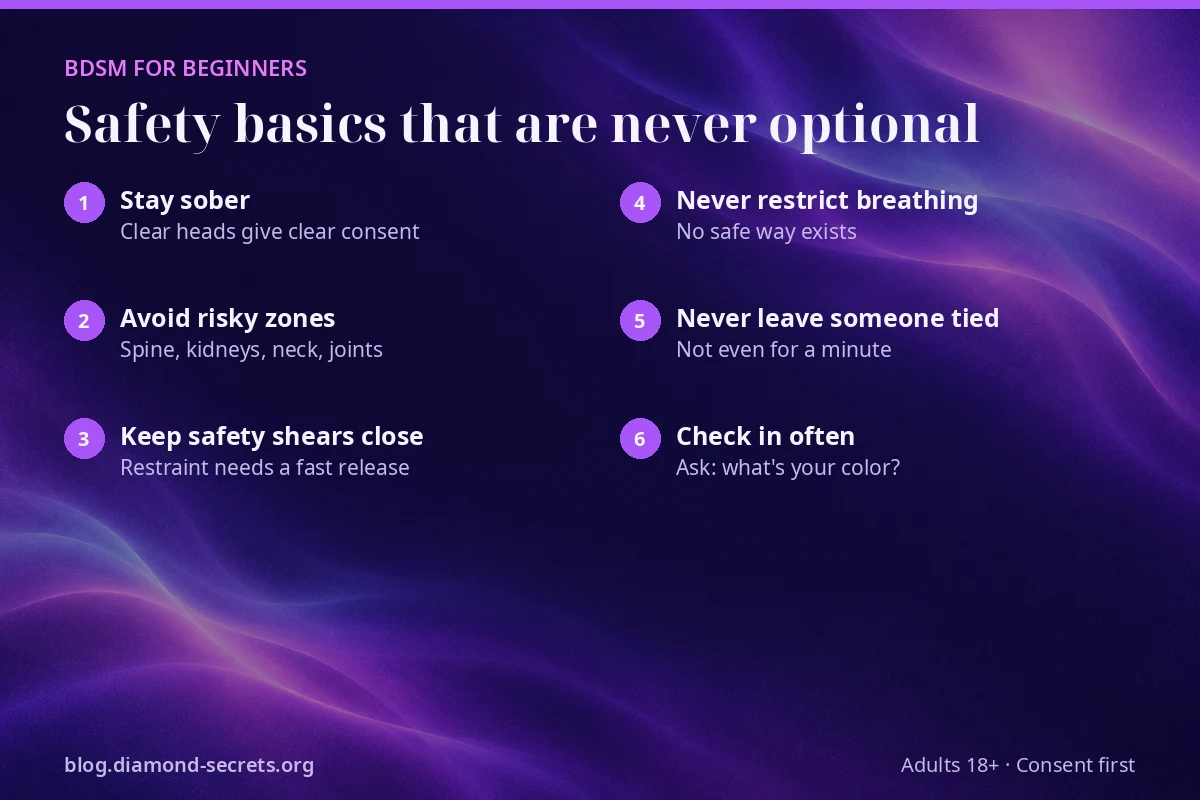
A responsible approach to BDSM for beginners always includes a few non-negotiable safety habits:
- Sober play. Alcohol and drugs blur consent and judgment. Keep scenes sober, especially early on.
- Know the risky zones. Avoid impact on the spine, kidneys, neck, and joints. Fleshy, padded areas are far safer.
- Keep safety shears nearby. Any time something restrains a person, you need a fast way to undo it.
- Never restrict breathing. There is no safe way to do it, and the risks include serious injury and death.
- Never leave a restrained person alone. Not even for a minute.
- Check in often. A quick “color?” costs nothing and builds trust.
If you ever need medical or mental health care, the National Coalition for Sexual Freedom maintains resources for finding kink-aware professionals who will not judge you.
A Sample First Scene Plan
Abstract advice only goes so far. Here is what a simple first scene might look like for two partners trying BDSM for beginners together. Treat it as an example to adapt, not a script to follow.
- Earlier that day: a 15-minute chat over coffee. You agree on a light power dynamic: one partner gives simple instructions, the other follows them. Hands only, no implements. Traffic light safe words.
- Setting the space: a warm room, water nearby, phones on silent, a blanket ready for afterward.
- The scene: 20 to 30 minutes. The partner in charge checks in with “color?” every few minutes. Nothing new gets added mid-scene.
- Ending: a clear signal that the scene is over, like a hug or saying “we’re done.”
- Aftercare: water, cuddling or space as requested, and a few kind words.
- Next day: a short message asking how you both feel and what you would change.
That is it. No elaborate equipment, no marathon session. When it comes to BDSM for beginners, a short, well-planned scene teaches you more than a long, chaotic one, and it builds the trust you need to explore further.
Exploring BDSM for Beginners Online
Many people explore their interests through conversation long before anything physical happens. Text chat lets you learn vocabulary, hear how other people handle negotiation, and figure out what genuinely excites you, all from behind a screen name.
A few habits make online exploration safer:
- Stay anonymous at first. Use a username that is not linked to your real name or social media. Our adult chat privacy checklist covers the details.
- Use moderated rooms. Rules and staff make a big difference. Read our community guidelines to see how we handle it.
- Watch for pressure. Anyone who rushes you, demands photos, or claims you must obey because they are “a Dom” is showing you a red flag. Learn the common BDSM red flags.
- Remember chat etiquette. Online scenes still need negotiation and limits. Our BDSM chat etiquette guide explains how it works in text.
How to Bring It Up With a Partner
If you are in a relationship, the idea of raising kink can feel bigger than the kink itself. Start outside the bedroom, at a calm moment. Frame it as curiosity rather than a confession: “I read something interesting and I’d love to know what you think.” Share one specific idea instead of a whole list.
Give your partner room to think, and accept that a no or a not yet is a valid answer. Our guide to talking about kink with a partner includes scripts you can borrow.
Common Mistakes in BDSM for Beginners
- Skipping the talk because it feels awkward. Awkward talking beats a confusing scene every time.
- Copying fiction. Books and films skip negotiation and aftercare. Real kink does not.
- Treating a role as a personality. Being submissive in a scene does not mean being a doormat in life. Being dominant does not mean being controlling outside agreed play.
- Ignoring your gut. If something feels off, it is fine to stop, even if you cannot explain why.
- Forgetting the drop. Feeling low after play is normal. Learn about sub drop and how to recover.
Myths About BDSM for Beginners
A lot of hesitation comes from myths picked up from films, jokes, or the internet. Clearing them up makes BDSM for beginners much less intimidating.
- “You have to go all in.” You do not. Many people enjoy a little light kink now and then and never go further. That is a completely valid way to practice BDSM.
- “Kink always involves pain.” Plenty of kink is about trust, roleplay, restraint, or power with no pain at all.
- “Submissives are weak.” Choosing to submit takes self-knowledge and courage. Many submissives are confident leaders in everyday life.
- “Experienced people never get nervous.” Even seasoned players feel butterflies with a new partner. Nerves are a reason to talk more, not a reason to stop.
The more you learn, the clearer it becomes that BDSM for beginners is mostly about communication. The activities are the easy part.
A Quick Checklist Before Your First Scene
- We have talked about what we both want, and what we do not.
- We have agreed on safe words and a nonverbal signal.
- We are both sober and well rested.
- Water, a blanket, and safety shears are within reach.
- We know what aftercare each of us needs.
- We have planned a check-in for the next day.
If you can tick every box, you are ready. If not, take a little more time. Rushing is the one thing every guide to BDSM for beginners warns against.
Frequently Asked Questions
Is it normal to be curious about kink?
Yes. Surveys consistently find that a large share of adults have fantasies involving power, restraint, or sensation. Curiosity is not a diagnosis.
Do I need to know whether I am dominant or submissive?
No. Many people switch, and many discover their preferences only after some exploration. BDSM for beginners is about learning, not labeling.
Do I need to buy equipment?
Not at first. Many first experiences involve nothing more than words, hands, and a clear agreement. If you do buy gear later, buy from reputable sellers and learn how to use it safely.
What if I try something and do not like it?
Then you have learned something useful. Say so, stop, and talk about it afterward. A good partner will be glad you told them.
Your Next Step
BDSM for beginners comes down to curiosity, consent, and care. Learn the basics, talk honestly, start small, and look after each other afterward. Do that, and you have already done more than most people ever do.
If you would like a friendly place to ask questions, join the conversation in our BDSM room. It is moderated, adults-only, and full of people who remember what it felt like to be new.

PhoenixJenn (aka Symphony) is the founder of Diamond Secrets — the 18+ chat community she built from scratch because the internet needed a place that actually felt worth staying in. Part platform builder, part community guardian, part music obsessive, she handles everything from tech and design to cyber safety and community culture, which means no two days look the same.
She’s been building online communities for years and genuinely cares about getting it right — which is why Diamond Secrets keeps growing while other chat sites quietly fade away. Safety is baked in from the start here, not bolted on as an afterthought, and the warm atmosphere isn’t an accident either. That’s all her.
If Diamond Secrets feels like a hidden gem worth telling your friends about, that’s entirely on purpose.