
Power Exchange: 7 Honest Truths About D/s Relationships
A clear, grounded guide to power exchange and D/s relationships: how they work, seven honest truths, the different types, and how to keep a dynamic healthy.

Some people are drawn to kink for sensation. Others are drawn to something less visible: the feeling of handing over control, or of being trusted to take it. That is power exchange, the heart of dominant and submissive relationships, often written as D/s.
Power exchange can be a few hours on a Saturday night or a carefully negotiated part of everyday life. Either way, it rests on the same foundation: two adults agreeing, freely and clearly, to shift how power works between them. This guide shares seven honest truths about power exchange, explains the main types, and covers how to tell a healthy dynamic from an unhealthy one.
Everything here is written for consenting adults 18 and older.
Curious how others structure their dynamics? Join the conversation in our moderated BDSM chat room.
Table of Contents
What Is Power Exchange?
Power exchange is any agreed arrangement where one person takes on more authority and the other gives some of it up. The dominant partner leads, sets tasks, or makes certain decisions. The submissive partner follows, serves, or surrenders certain choices. The key word is agreed. The submissive partner is not losing power. They are lending it, on terms they set, and they can take it back.
That is why people in the community often say the submissive holds the real power. Their limits and their consent define the edges of everything the dominant is allowed to do.
It can be playful, sensual, deeply emotional, or all three. It can involve physical BDSM activities, or none at all. Some D/s couples never use restraints or impact. Their dynamic lives in rituals, words, and small acts of service.

7 Honest Truths About Power Exchange
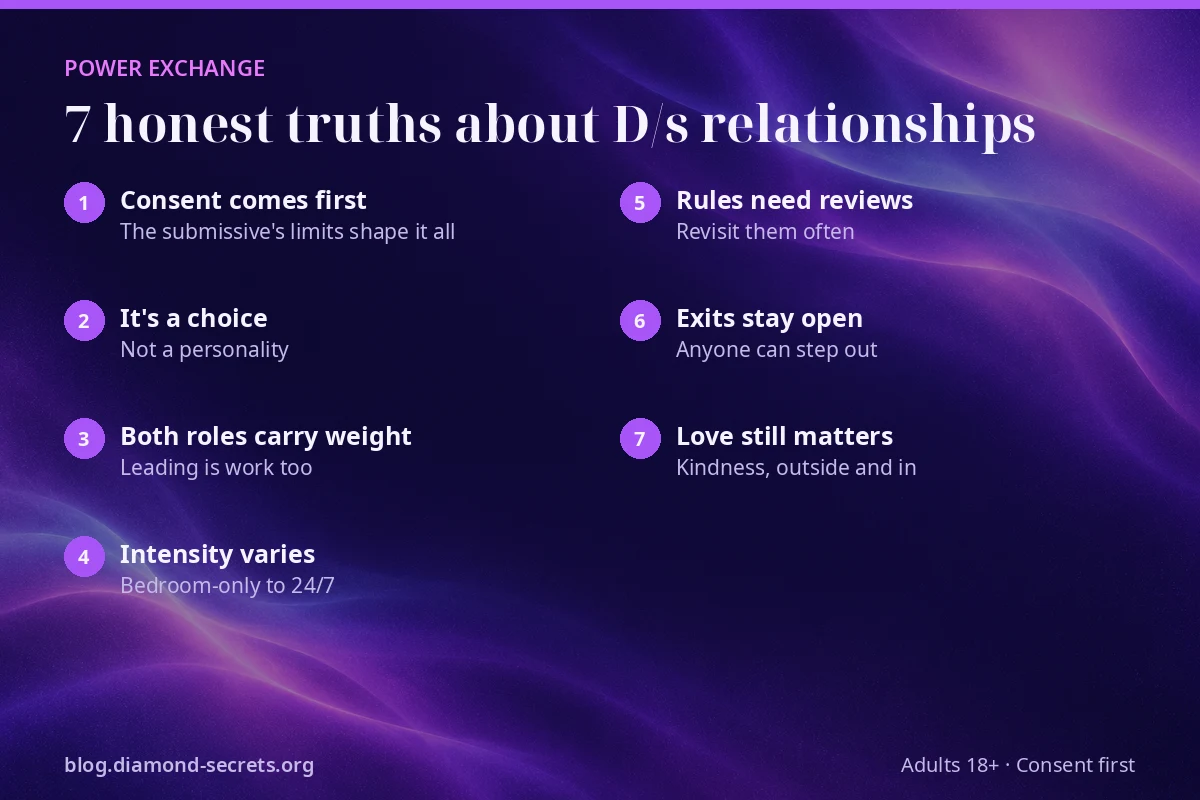
1. Consent comes before everything
Every healthy power exchange starts with negotiation and continues with consent. The dominant partner’s authority exists only because the submissive partner agreed to it, and only within the limits they set. Our BDSM negotiation guide and guide to hard and soft limits are good starting points.
2. It is a role, not a whole personality
Plenty of confident executives love to submit. Plenty of shy, gentle people love to lead. Your role in a power exchange says nothing about your worth, intelligence, or value as a person. Outside the dynamic, you are equals.
3. Both roles take real work
Dominance is not just getting your way. A good dominant pays close attention, plans carefully, takes responsibility for safety, and keeps the submissive’s wellbeing at the center. Submission is not passive either. It takes self-awareness, honesty about limits, and the courage to speak up.
4. Intensity is a dial, not a switch
Power exchange ranges from a single scene to a full-time arrangement. There is no correct level. Many couples move along the spectrum over time, turning things up during calm periods and down when life gets busy.
5. Rules need regular reviews
Rules and rituals are a big part of many D/s relationships: how the submissive greets the dominant, check-in messages, small tasks, forms of address. Healthy couples review these regularly, keep what works, and drop what does not.
6. The exit is always open
In a healthy power exchange, either person can pause the dynamic, renegotiate it, or end it. Safe words still apply, even outside scenes. If one partner feels they cannot leave, something has gone wrong.
7. Kindness still matters
Even a strict dynamic should feel good overall. The best D/s relationships combine structure with warmth, affection, and humor. If the power exchange is making someone consistently unhappy, it needs to change.
Types of Power Exchange
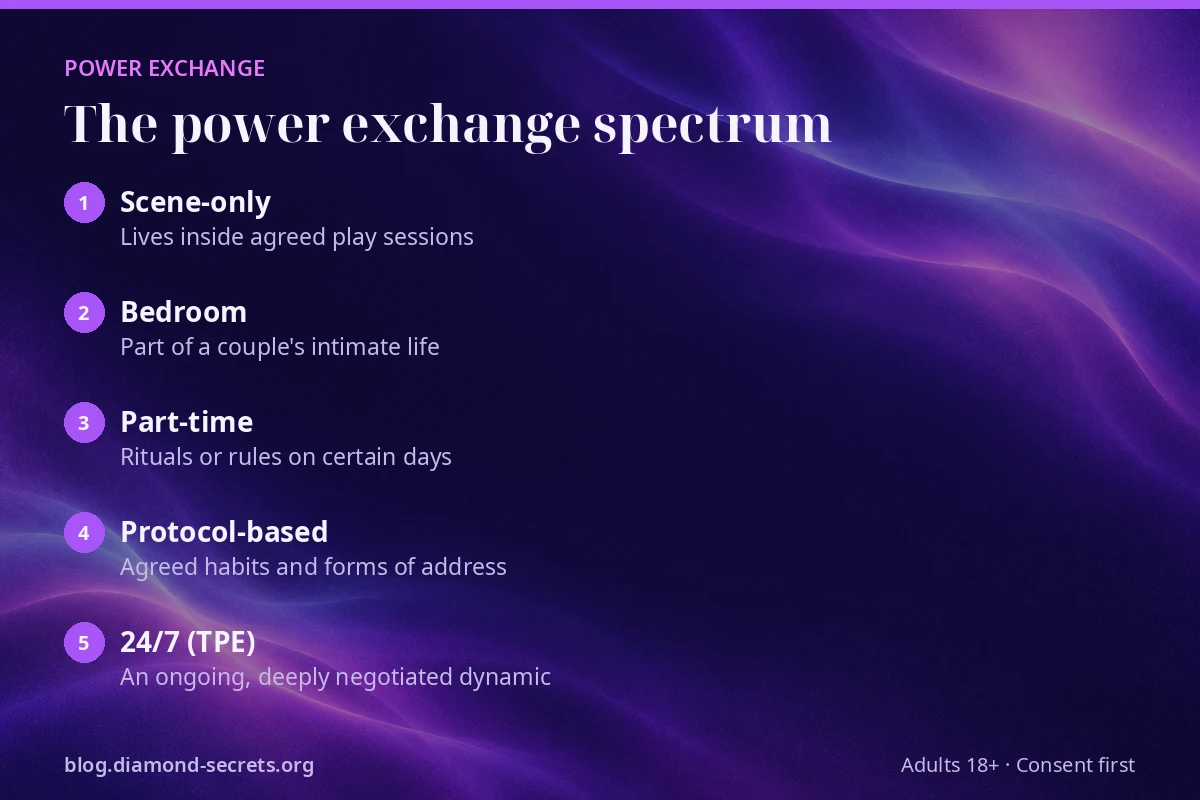
There is no single way to do it. These are the most common arrangements, roughly from lightest to most involved:
- Scene-only. The dynamic exists only during agreed play. When the scene ends, both partners return to everyday equality.
- Bedroom dynamic. Power exchange is part of a couple’s intimate life, but not the rest of their relationship.
- Part-time. Certain rules or rituals apply on specific days, evenings, or occasions.
- Protocol-based. The couple uses agreed habits, such as forms of address or daily tasks, that run in the background of ordinary life.
- 24/7 or total power exchange (TPE). The dynamic is ongoing and touches many areas of life. This requires very careful negotiation, regular review, and strong trust.
Common D/s dynamics and labels
Within these dynamics, people use many labels to describe their style. Dominant and submissive are the broadest. Others include Master or Mistress and slave, which usually describe a more intense, often protocol-heavy dynamic. Daddy or Mommy dominants and little partners focus on care and nurturing. Owner and pet dynamics often involve playful animal roleplay. None of these labels is required, and their meanings vary from couple to couple. What matters is that you both agree on what yours means. Our guide to BDSM terms explains more vocabulary.
How to Start a Power Exchange Dynamic
If you and a partner are curious, start small and talk a lot.
- Talk about the why. What draws each of you to this? Feeling cared for? Feeling trusted? Relief from decision-making? Structure?
- Agree on scope. Decide where the dynamic applies: only in scenes, only in the bedroom, or in other parts of life.
- Write down limits. Include hard limits, soft limits, and areas the dynamic must never touch, such as finances, work, or friendships.
- Try a few simple rules. A good-morning message, a specific way of asking permission, or a small daily task.
- Set a review date. Check in after two weeks. What felt good? What felt off?
- Keep safe words active. Make sure the submissive knows they can pause the power exchange at any time. Our safe words guide explains common systems.
Some couples write a relationship contract. It is not legally binding, but it is a helpful way to put agreements on paper and review them together.
Healthy Power Exchange vs Abuse
This is the most important section in this guide. Abuse sometimes hides behind the language of D/s. Knowing the difference protects you.
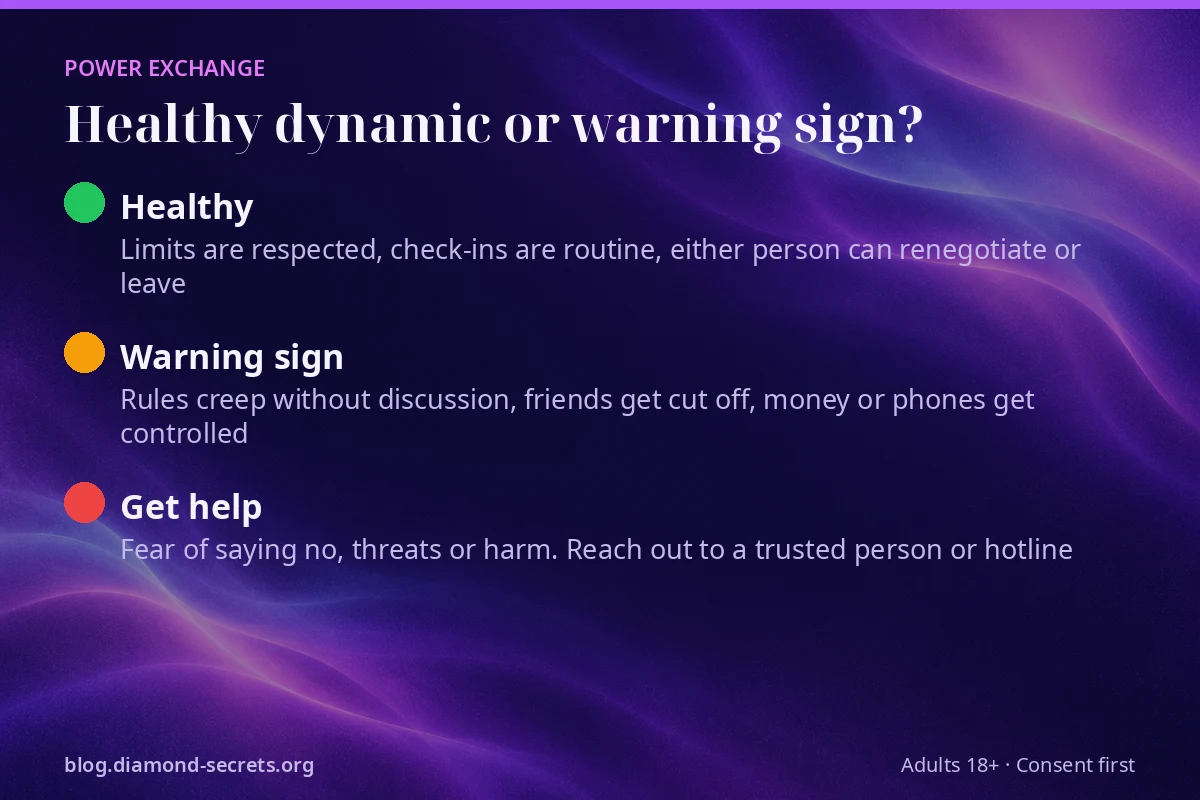
A healthy power exchange has these qualities:
- Limits are respected every time, without sulking or punishment.
- Both partners can raise concerns, renegotiate, or end the dynamic freely.
- The submissive keeps their friendships, money, phone, and independence unless they have explicitly and freely chosen otherwise, and can reverse that choice.
- Check-ins and reviews are routine.
- The relationship makes both people’s lives better.
Warning signs include rules that creep without discussion, isolation from friends or family, control over money or communication that was never agreed, punishments that feel genuinely frightening, and any sense that saying no is not safe. If that sounds familiar, read our list of BDSM red flags, and reach out for help. In the US, The National Domestic Violence Hotline offers confidential support, and they understand that abuse can happen in any kind of relationship.
Power Exchange Online
Many people explore power exchange through text first. Online D/s can be fun, creative, and a safe way to learn what you enjoy. It also comes with specific risks. People sometimes claim a dominant title to pressure newcomers into sending photos or money, or into skipping negotiation entirely.
- Never agree to rules involving money, photos, or personal information with someone you have just met.
- Keep your real name and location private. Our adult chat privacy checklist helps.
- Negotiate online scenes as carefully as in-person ones. See our BDSM chat etiquette guide.
- Use moderated spaces, where staff enforce clear rules. Our BDSM room is a good place to meet people who take consent seriously.
Rituals and Rules in Practice
Rituals are where many people feel a power exchange most vividly. They are small, repeated acts that remind both partners of the dynamic. Some common examples:
- A morning or evening check-in message, sent at an agreed time.
- Asking permission before certain choices, like what to wear on a date night.
- A specific form of address used in private.
- A weekly review where both partners talk about how the dynamic is going.
- Small acts of service, like making the dominant’s coffee, offered with intention.
- A gesture, like kneeling briefly, that marks the start of a scene.
Good rules are specific, achievable, and kind. They should add meaning to the relationship, not stress. If a rule starts causing anxiety, raise it at your next review and adjust it. A power exchange is meant to serve both people.
Power Exchange and Everyday Life
Even the most dedicated D/s couples live in the real world. Jobs, families, illness, and stress all affect how much energy anyone has for a dynamic. Many couples agree in advance how they will handle these moments: pausing rules during a busy week, or switching to a lighter version when someone is unwell. Planning for real life keeps the power exchange sustainable for the long term.
Frequently Asked Questions
Does power exchange have to be sexual?
No. Many dynamics are partly or entirely non-sexual, built on service, structure, and care.
Can a power exchange work in a long-term relationship?
Yes. Many couples have practiced D/s for decades. Regular reviews and honest communication keep it fresh and healthy.
What if I want to stop?
Then say so. A healthy partner will respect that, talk it through, and return the relationship to a vanilla footing or end it if you both prefer.
Can I be submissive and still be a strong person?
Absolutely. Choosing to submit takes trust, self-knowledge, and courage. Strength and submission are not opposites.
Power Exchange, Built on Trust
At its best, power exchange is a deeply trusting relationship where structure creates freedom, and both partners feel seen. Start slow, keep talking, review often, and never let the dynamic outrank the people in it.
New to all of this? Read our BDSM for beginners guide, then come meet the community in our BDSM chat room.

PhoenixJenn (aka Symphony) is the founder of Diamond Secrets — the 18+ chat community she built from scratch because the internet needed a place that actually felt worth staying in. Part platform builder, part community guardian, part music obsessive, she handles everything from tech and design to cyber safety and community culture, which means no two days look the same.
She’s been building online communities for years and genuinely cares about getting it right — which is why Diamond Secrets keeps growing while other chat sites quietly fade away. Safety is baked in from the start here, not bolted on as an afterthought, and the warm atmosphere isn’t an accident either. That’s all her.
If Diamond Secrets feels like a hidden gem worth telling your friends about, that’s entirely on purpose.