
Hard and Soft Limits: 6 Easy Steps to a Yes/No/Maybe List
What hard and soft limits are, how they differ, real examples, and six easy steps to build a yes/no/maybe list you can share with a partner.

Limits are not a buzzkill. They are the map that tells everyone where the fun is. Knowing your hard and soft limits, and sharing them clearly, is one of the most important things you can do before any kind of kink play.
This guide explains the difference between hard and soft limits, gives examples, and walks you through six easy steps to build a yes/no/maybe list you can actually use.
Everything here is written for consenting adults 18 and older.
Want to compare notes with others? Visit our moderated BDSM chat room.
Table of Contents
What Are Hard and Soft Limits?
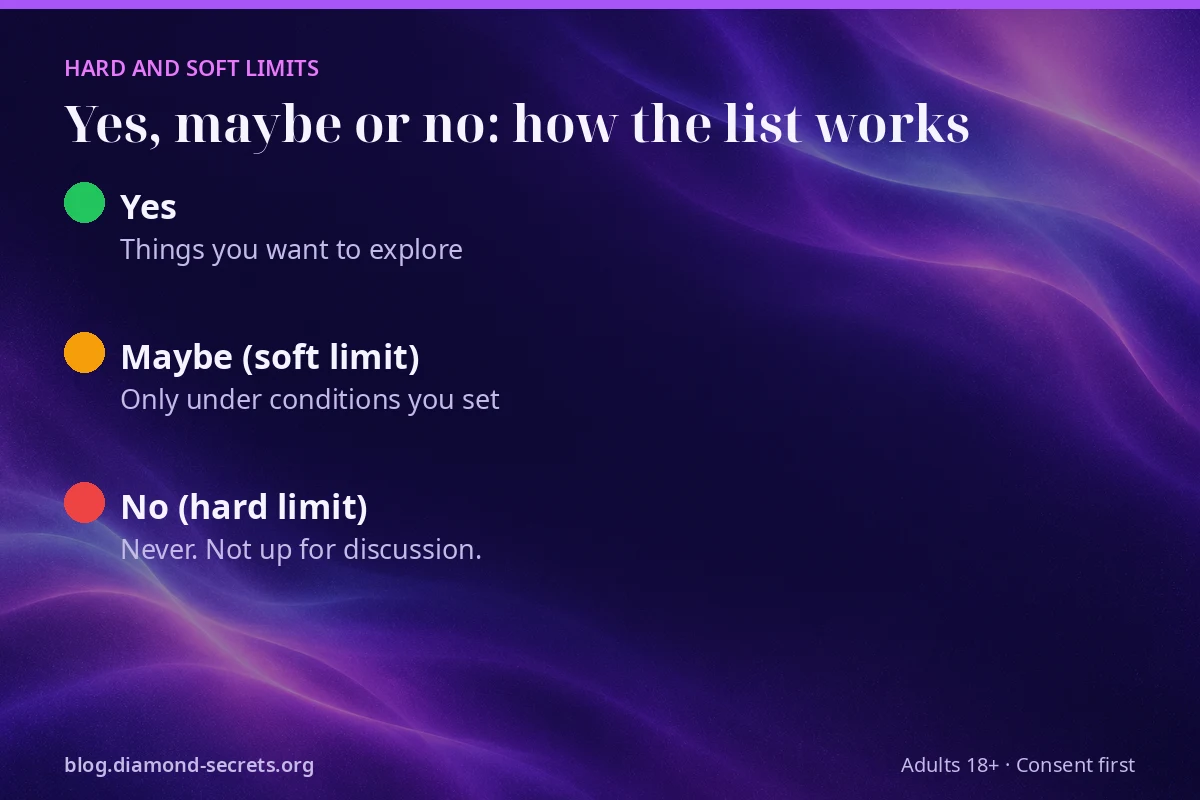
A hard limit is something you will not do, under any circumstances. It is not up for discussion during a scene, and a good partner will never try to push it.
A soft limit is something you are hesitant about. You might try it under specific conditions, with a trusted partner, at a slow pace, or in a particular mood. Soft limits can shift over time, but only when you choose to shift them.
Together, hard and soft limits describe the edges of your consent. They protect you physically and emotionally, and they help your partner relax because they know exactly where the lines are.
Limits versus boundaries
You will hear both words. Limits usually describe specific activities in a scene. Boundaries are broader: how often you play, whether you play with others, what you share online, how you want to be spoken to outside of play. Both deserve the same respect, and a good partner asks about both.

Why Hard and Soft Limits Matter
Kink often plays with intensity, power, and the feeling of losing control. That only works when the real control stays with the people involved. Limits are how that happens.
- They prevent harm. Physical limits protect injuries and health conditions. Emotional limits protect against triggers and trauma.
- They build trust. When a partner respects your limits every time, you can relax into play.
- They improve play. Clear hard and soft limits leave more room for creativity inside them.
Examples of Hard and Soft Limits
Everyone’s list is different. These are common examples, not recommendations:
Common hard limits
- Anything that restricts breathing
- Permanent marks or injuries
- Specific words, names, or slurs
- Photos or video of any kind
- Involving anyone not part of the negotiation
- Activities tied to a past trauma
Common soft limits
- Impact with implements rather than hands
- Blindfolds or sensory deprivation
- Certain roleplay themes
- Degrading or humiliating language
- Play that leaves temporary marks
- Longer or more intense scenes
Notice that one person’s hard limit is another person’s favorite activity. That is completely normal, and no list is better than another.
6 Easy Steps to Your Hard and Soft Limits List
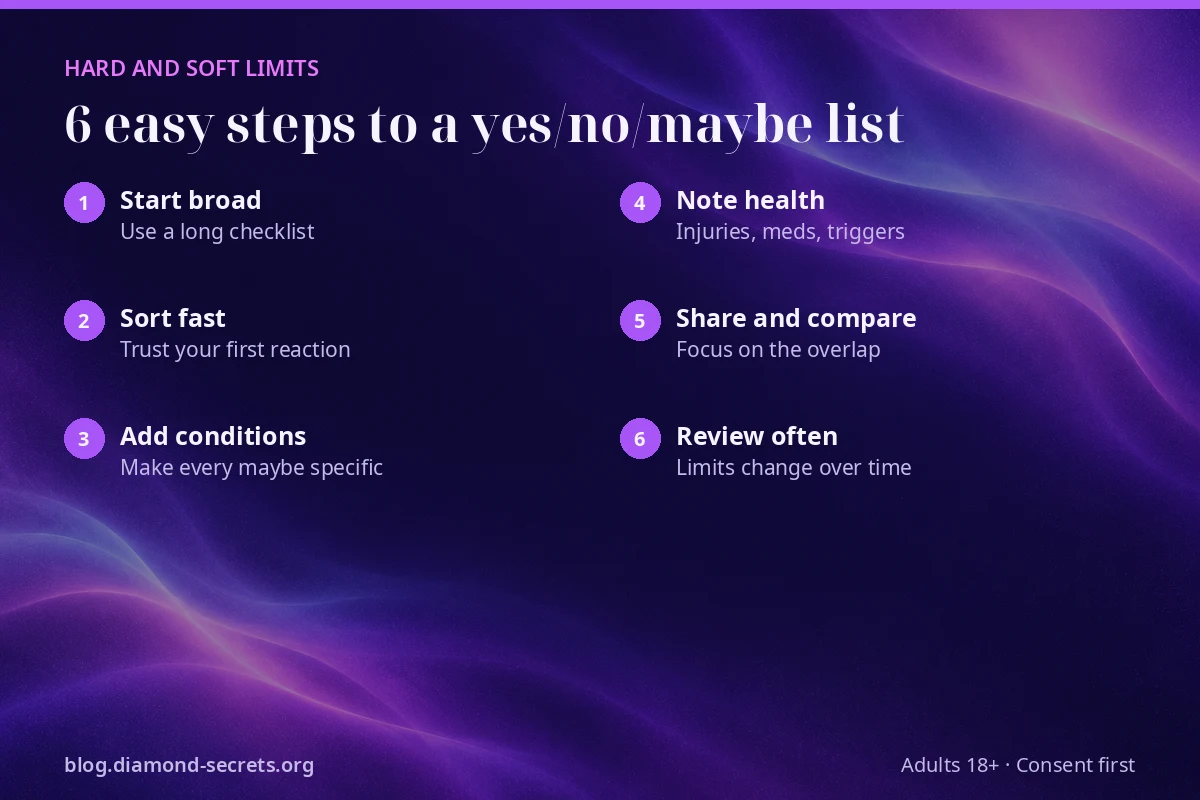
1. Start with a broad checklist
Find a kink checklist online or write your own list of activities, themes, words, and settings. Include things you have never considered. Reading a long list often reveals hard and soft limits you did not know you had.
2. Sort into yes, no, and maybe
Mark each item quickly. Yes means you are interested. No is a hard limit. Maybe is a soft limit or something you are unsure about. Trust your first reaction.
3. Add conditions to every maybe
For each soft limit, write what would make it feel okay. “Only with a long-term partner.” “Only very lightly.” “Only if we talk about it first.” Those conditions are what make soft limits useful.
4. Note physical and emotional factors
Add anything that affects safety: injuries, health conditions, medications, or topics that trigger strong emotions. These often become hard limits automatically.
5. Share and compare
Exchange lists with your partner during BDSM negotiation. Focus on overlap: things you both marked yes. Treat any mismatch with curiosity, not pressure.
6. Review regularly
Hard and soft limits change. Revisit your list every few months, after a new experience, or any time something feels different.
Example Entries From a Yes/No/Maybe List
Here is how a few lines on a finished list might look. The detail in the maybe column is what makes hard and soft limits genuinely useful:
- Blindfolds: Maybe. Only with a partner I have played with at least three times, and only for short periods.
- Light spanking with a hand: Yes.
- Paddles or other implements: Maybe. Start very light, check in often.
- Being called names: No. Praise only.
- Restraint with cuffs: Maybe. Wrists only, never ankles, shears within reach.
- Photos or video: No.
- Orders and instructions: Yes, as long as they stay inside the scene.
Compare that with a list that just says “blindfolds: maybe.” The second version leaves your partner guessing. The first tells them exactly how to make it work for you.
Finding Limits You Did Not Know You Had
Sometimes you only discover a limit when you reach it. A word lands badly, a position brings back a memory, or a sensation you expected to love feels wrong. That is not a failure. It is information.
- Use your signals. Call yellow or red as soon as something feels off.
- Talk about it afterward. Once you are calm, figure out what exactly did not work.
- Update the list. Add the new limit so it is clear for next time.
- Be kind to yourself. Discovering hard and soft limits through experience is part of learning what you like.
How to Respect Hard and Soft Limits
Having a list is only half the job. Here is how to honor someone else’s hard and soft limits:
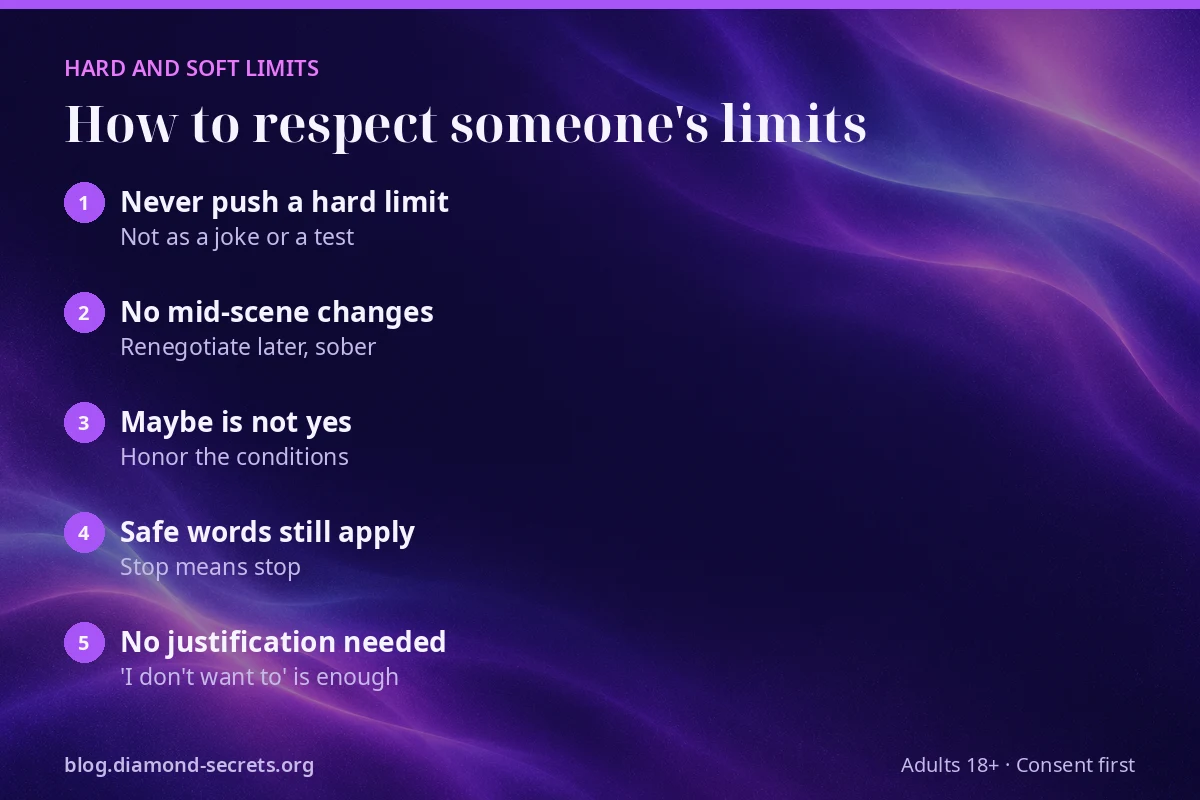
- Never push a hard limit. Not as a joke, not as a test, not “just a little.”
- Never negotiate a limit mid-scene. Someone deep in a scene cannot give clear consent to change the rules.
- Treat maybes as conditional. A soft limit is not a yes waiting to happen.
- Keep using safe words. Even inside agreed limits, anyone can stop at any time.
- Do not ask for justifications. “I don’t want to” is a complete reason.
When Limits Change
It is normal for a soft limit to become a yes over time, or for a yes to become a no. Grief, stress, health changes, or a bad experience can all shift what feels okay. Talk about changes before play, never during, and update your shared list.
A partner who complains that your hard and soft limits are “too many” or tries to wear them down is showing a warning sign. Read our guide to BDSM red flags for more.
Hard and Soft Limits in Online Play
Text and voice roleplay need limits too. Before an online scene, share a short list of themes you love, themes that are off the table, and how you will step out of character.
Many chat players keep a short limits section in their profile so partners know the basics before messaging. Our BDSM chat etiquette guide explains how to raise limits in text, and our guide to setting boundaries in adult chat covers saying no gracefully. Moderated spaces like our BDSM room also enforce clear rules that back up your limits.
What to Do If a Limit Is Crossed
If a partner crosses a hard limit, stop the scene. Take care of yourself first. Then decide whether you want to talk about it, take a break, or end the relationship. Crossing a hard limit on purpose is a consent violation, not a misunderstanding.
If you need support, RAINN offers free, confidential help. For online incidents, block and report. Here is how reporting works on Diamond Secrets.
Talking About Hard and Soft Limits Without Awkwardness
Sharing hard and soft limits can feel exposing, especially early on. A few approaches make it easier:
- Fill in lists separately first. Then compare. You will both be more honest without someone watching.
- Start with the yes column. Talking about what excites you sets a warm tone before you get to the no column.
- Use neutral language. “That’s a no for me” is enough. You do not have to defend or justify it.
- Thank each other. Every limit shared is an act of trust. Acknowledge it.
- Keep humor handy. Laughing about an unexpected answer can ease tension, as long as nobody is laughing at the other person.
Hard and Soft Limits for the Dominant Partner
Limits are not just for submissives. Dominants and tops have hard and soft limits too, and they deserve the same respect. A top might be unwilling to use certain words, uncomfortable with specific roleplay themes, or unwilling to leave marks. A good partner asks the dominant about their limits too, rather than assuming they will do anything requested.
When both partners share hard and soft limits openly, the result is a scene that feels good to everyone, not one person’s fantasy at the other’s expense.
Frequently Asked Questions
Do I have to explain my hard limits?
No. You can share the reason if you want to, but a limit is valid without one.
Can I have no hard limits?
Experienced players almost always have some, even if just around safety. “No limits” claims, especially from someone you just met, deserve skepticism.
What if my partner’s hard limit is my favorite thing?
That can be disappointing, but it is not negotiable. Focus on what you share, and talk about whether the mismatch matters for your relationship.
Your Limits, Your Map
Hard and soft limits are not walls. They are a map of where you both want to go together. Write yours down, share them, review them often, and expect them to be respected every time.
Just getting started? Read our BDSM for beginners guide, then come share your list ideas in our BDSM chat room.

PhoenixJenn (aka Symphony) is the founder of Diamond Secrets — the 18+ chat community she built from scratch because the internet needed a place that actually felt worth staying in. Part platform builder, part community guardian, part music obsessive, she handles everything from tech and design to cyber safety and community culture, which means no two days look the same.
She’s been building online communities for years and genuinely cares about getting it right — which is why Diamond Secrets keeps growing while other chat sites quietly fade away. Safety is baked in from the start here, not bolted on as an afterthought, and the warm atmosphere isn’t an accident either. That’s all her.
If Diamond Secrets feels like a hidden gem worth telling your friends about, that’s entirely on purpose.