
Talking About Kink: 7 Easy Scripts for Your Partner
Seven easy scripts for talking about kink with a partner, plus timing tips, how to handle any answer, and how to keep the conversation going.

For many people, the hardest part of exploring kink is not the kink. It is saying the first sentence out loud. Talking about kink with a partner can bring up worries about being judged, rejected, or seen differently. Those fears are understandable, and they are usually much bigger than the conversation turns out to be.
This guide gives you seven easy scripts to start talking about kink, tips on timing, a guide to handling every kind of response, and ideas for keeping the conversation going. It works whether you have been together for two months or twenty years.
Everything here is written for consenting adults 18 and older.
Want to rehearse with people who have been there? Our moderated BDSM chat room is full of people who remember their first conversation.
Table of Contents
Why Talking About Kink Is Worth It
Keeping desires hidden can create distance in a relationship. You might feel unseen, or worry that your partner would not love the real you. Talking about kink, even if the answer is not yes, often brings couples closer. It shows trust, and it invites your partner to share their own hidden curiosities.
Many people find that their partner has been curious too, but was just as nervous to say so. Kink interests are far more common than most people assume, as research from the Kinsey Institute has repeatedly shown.

Before You Start Talking About Kink
A little preparation makes the conversation calmer:
- Get clear on what you want to share. Pick one or two specific interests rather than an overwhelming list.
- Know why it matters to you. Is it about feeling trusted? Playful? Cared for? Explaining the feeling often lands better than naming the activity.
- Learn the basics. Our BDSM for beginners guide and glossary of BDSM terms help you explain clearly.
- Prepare for any answer. Remind yourself that a no is not a rejection of you.
When to Start Talking About Kink
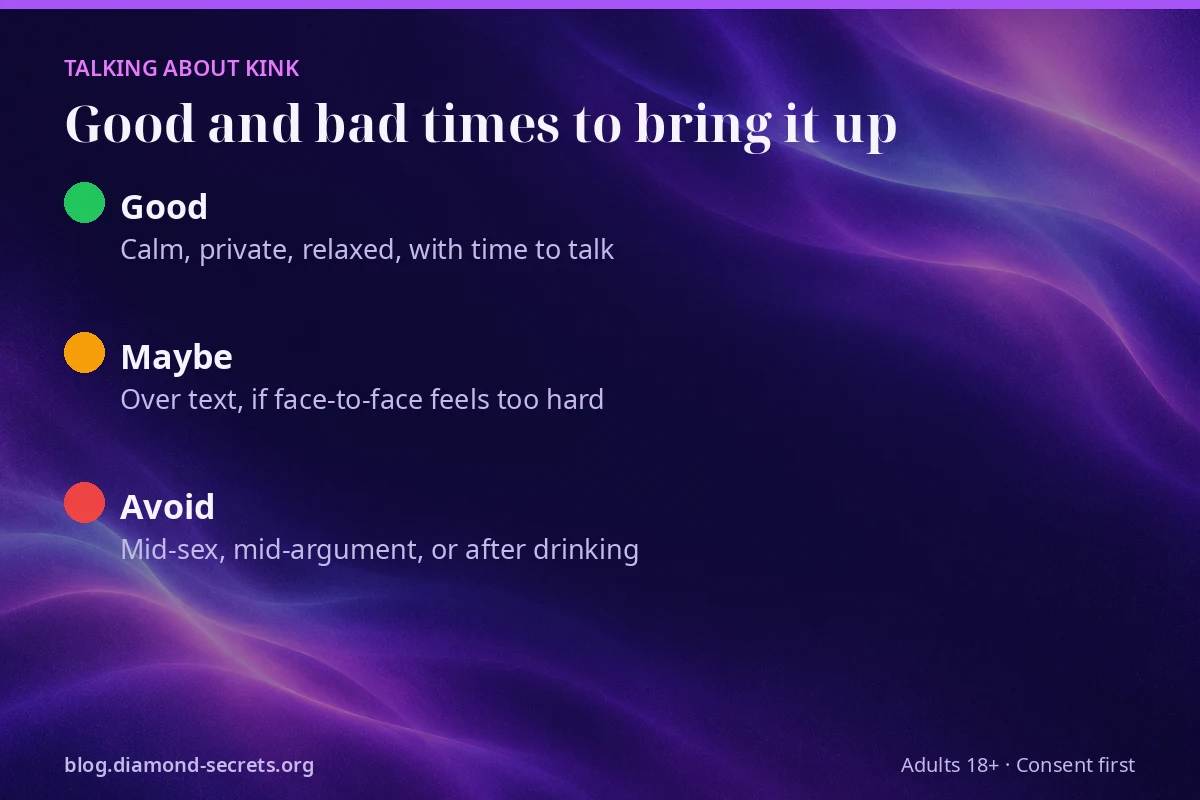
Timing matters more than wording. The best moments are calm, private, and unhurried: a slow evening at home, a long walk, a drive. Avoid bringing it up in the middle of sex, during or after an argument, or after drinking. Those moments add pressure and make it harder for your partner to respond honestly.
If face-to-face feels too intense, a message can be a gentle opener: “There’s something I’d like to talk about this weekend. It’s nothing bad, just something I’ve been curious about.”
7 Easy Scripts for Talking About Kink
Borrow these, adjust the words, and make them yours.
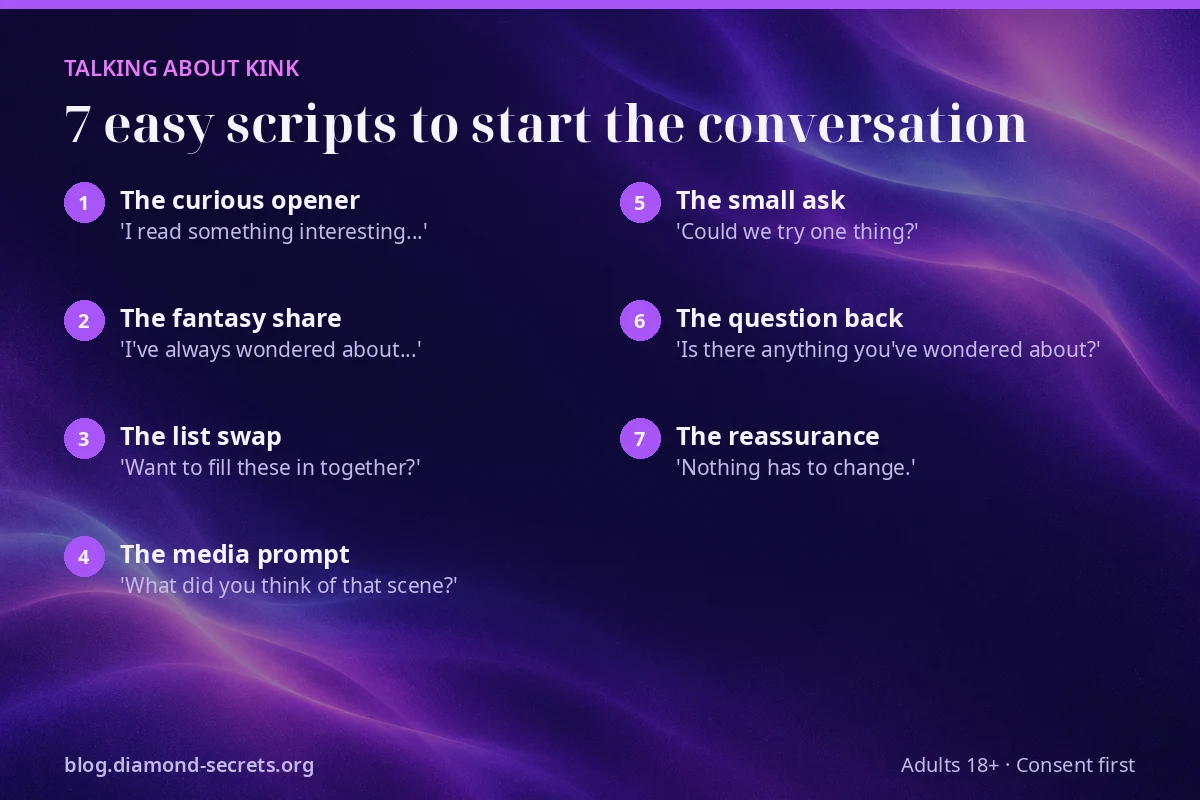
1. The curious opener
“I read an article about something called power exchange, and it got me thinking. Can I tell you about it?” This frames talking about kink as curiosity, not confession.
2. The fantasy share
“I’ve always wondered what it would be like to be blindfolded. Would you ever be curious about that?” Simple, specific, and easy to answer.
3. The list swap
“I found this yes/no/maybe list. Want to fill it in separately and compare?” Lists take the pressure off and often reveal surprising overlaps. Our guide to hard and soft limits explains how they work.
4. The media prompt
“What did you think of that scene in the show we watched?” Fiction can be a low-stakes way into talking about kink, though remember that most fiction skips the consent parts.
5. The small ask
“Could we try something small? I’d love it if you held my wrists next time.” One concrete request is easier to say yes to than a whole new dynamic.
6. The question back
“Is there anything you’ve ever been curious about but never mentioned?” This turns the conversation into a two-way exchange.
7. The reassurance
“I want you to know this isn’t about anything missing between us. I love what we have. This is just something I’d like to explore together, and nothing has to change if you’re not interested.”
How to Handle Every Response
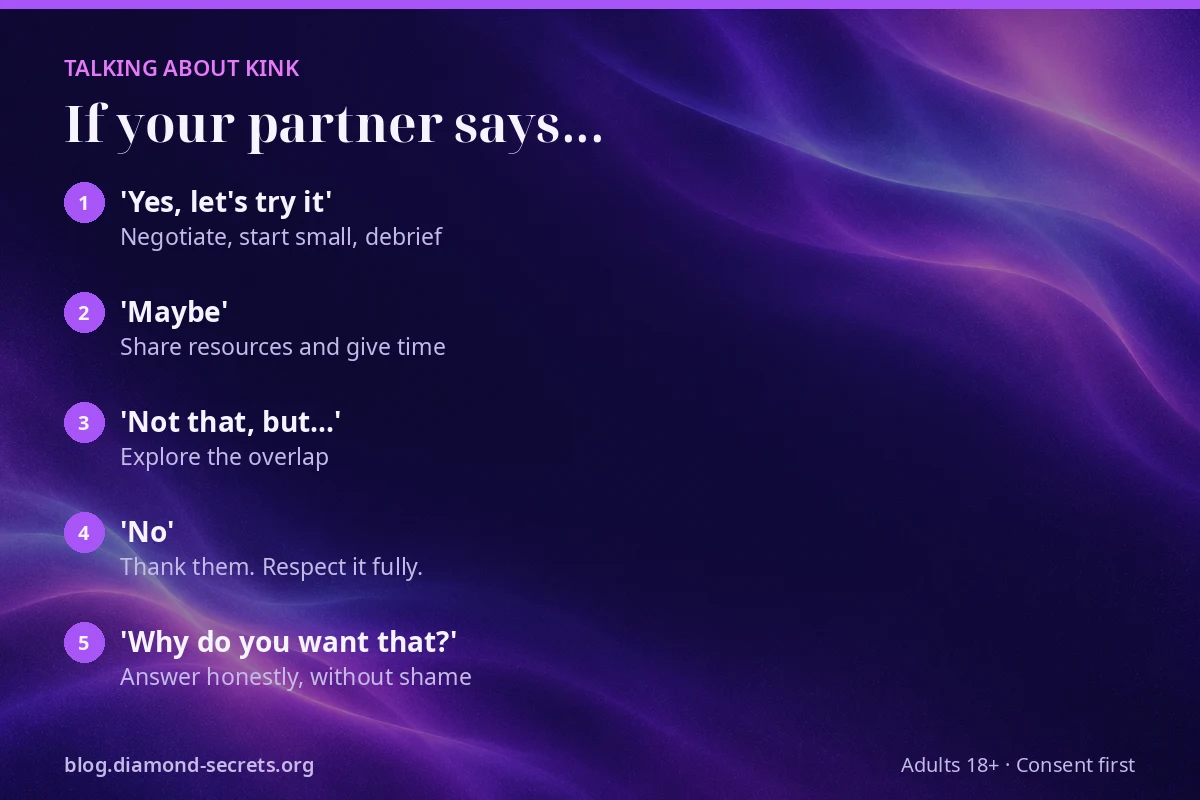
If they say yes
Wonderful. Slow down anyway. Agree on a small first step, set safe words, and plan aftercare. Our BDSM negotiation guide walks you through the details.
If they say maybe
Give them time. Share a beginner-friendly article, and offer to talk again in a week. Maybe often becomes yes once people feel informed and unpressured.
If they say not that, but something else
Explore the overlap. Your partner may not want restraint but might love a playful power dynamic. Talking about kink is a negotiation, not an all-or-nothing pitch.
If they say no
Thank them for listening, and respect the answer fully. Do not keep reopening the topic. You can ask whether they would be open to revisiting it someday, but accept whatever they say.
If they ask why
Answer honestly, without shame. “It makes me feel trusted” or “I like the idea of letting go” is enough. You do not need a deep psychological explanation.
What to Avoid When Talking About Kink
- Springing it during sex. Consent needs a clear head.
- Framing it as a fix. “Our sex life is boring, so…” puts your partner on the defensive.
- Pressure or ultimatums. A yes given under pressure is not real consent.
- Comparing them to others. Talking about an ex’s kinks rarely goes well.
- Dumping everything at once. Start with one idea. There will be time for more.
If Your Partner Shares a Kink With You
Sometimes you are on the other side of the conversation. If your partner opens up, remember how hard it probably was for them. Thank them. Ask questions with curiosity rather than judgment. You do not have to say yes, and you do not have to decide on the spot. “Thank you for telling me. Can I think about it and we’ll talk more?” is a kind and honest response.
Keep Talking About Kink Over Time
Talking about kink is not a one-time event. Interests evolve, comfort levels shift, and new ideas come up. Many couples set aside time every few months to check in: what are we enjoying, what do we want to try, what should we drop?
Regular conversations keep things healthy and fun, and they make every future conversation easier. If something ever feels off, our guide to BDSM red flags can help you tell the difference between nerves and genuine warning signs.
Exploring Without a Partner
If you are single, or your partner is not interested, talking about kink with community can still be valuable. Text chat lets you learn, ask questions, and explore your interests anonymously. Our BDSM chat room is moderated, adults-only, and full of people who enjoy talking about kink thoughtfully. If you are new to chat, our BDSM chat etiquette guide explains the basics, and our community guidelines explain how we keep the space respectful.
Talking About Kink in a New Relationship
In a new relationship, the question is often when, not how. There is no perfect moment, but a few principles help:
- Raise it before it becomes a secret. Mentioning an interest early, even lightly, prevents the feeling of a big confession later.
- Start with values, not details. “Communication and trust matter a lot to me in intimacy” opens the door without oversharing.
- Watch how they respond to small things. If they handle a light mention kindly, you can share more as trust grows.
- Stay safe. Do not share detailed personal information or photos with someone you have only just met. Our guide to BDSM red flags covers what to watch for.
Talking About Kink in a Long-Term Relationship
After years together, talking about kink can feel riskier because there is more history at stake. You might worry your partner will wonder why you never said anything before. Acknowledge that directly: “I’ve been nervous to bring this up because I didn’t want you to think anything was wrong. Nothing is wrong. I just want to share more of myself with you.”
Long-term partners also have a huge advantage: deep trust and familiarity. Many couples find that talking about kink later in a relationship adds a fresh sense of discovery and play.
Writing It Down Instead
If speaking feels impossible, writing can be just as effective. A thoughtful letter, a shared document, or a list you both fill in gives each person time to think before responding. Some couples keep a shared notes file where either partner can add ideas whenever they come up, then talk about them on a set evening each month. That routine makes talking about kink feel ordinary instead of dramatic.
Frequently Asked Questions
What if I am too embarrassed to say it out loud?
Write it down. A note, a message, or a shared list can do the talking for you.
Should I share all my fantasies at once?
No. Start with one or two that matter most. You can share more as trust builds.
What if my partner reacts badly?
Give them space, and do not argue in the moment. If they mock or shame you repeatedly, that is worth taking seriously, and a couples therapist who is kink-aware may help. The National Coalition for Sexual Freedom lists resources.
The First Sentence Is the Hardest
Talking about kink takes courage, but it rarely goes as badly as we fear. Pick a calm moment, choose one script, stay curious, and respect the answer. However it goes, you will have shown your partner something real, and that is worth a lot.
Want support along the way? Come say hello in our BDSM chat room.

PhoenixJenn (aka Symphony) is the founder of Diamond Secrets — the 18+ chat community she built from scratch because the internet needed a place that actually felt worth staying in. Part platform builder, part community guardian, part music obsessive, she handles everything from tech and design to cyber safety and community culture, which means no two days look the same.
She’s been building online communities for years and genuinely cares about getting it right — which is why Diamond Secrets keeps growing while other chat sites quietly fade away. Safety is baked in from the start here, not bolted on as an afterthought, and the warm atmosphere isn’t an accident either. That’s all her.
If Diamond Secrets feels like a hidden gem worth telling your friends about, that’s entirely on purpose.