
BDSM Terms: 40 Essential Words for Confident Beginners
A plain-language glossary of 40 essential BDSM terms for beginners, grouped by roles, safety, activities, feelings and community.

Walking into a kink conversation for the first time can feel like landing in a country where everyone speaks a slightly different language. People mention scenes, switches, drops, and munches as if everyone knows what they mean. This glossary of BDSM terms is here to fix that.
Below you will find 40 essential BDSM terms, explained in plain words and grouped by theme: roles, safety and consent, activities, feelings, and community. Learning them will make it easier to ask for what you want, understand what others are offering, and spot when someone is misusing the language.
Everything here is written for consenting adults 18 and older.
Have a word we missed? Ask in our moderated BDSM chat room.
Table of Contents
Why Learning BDSM Terms Helps
Shared vocabulary makes negotiation faster and clearer. When you can say “I am a switch with a soft limit around impact,” your partner knows exactly where you stand. Knowing BDSM terms also protects you. If someone claims that “real submissives have no limits,” you will know that is not what the words mean.
One caution: meanings vary between communities, countries, and individuals. Treat these definitions as a starting point, and always ask a partner what a word means to them.

BDSM Terms for Roles
- BDSM. An umbrella term for bondage and discipline, dominance and submission, and sadism and masochism.
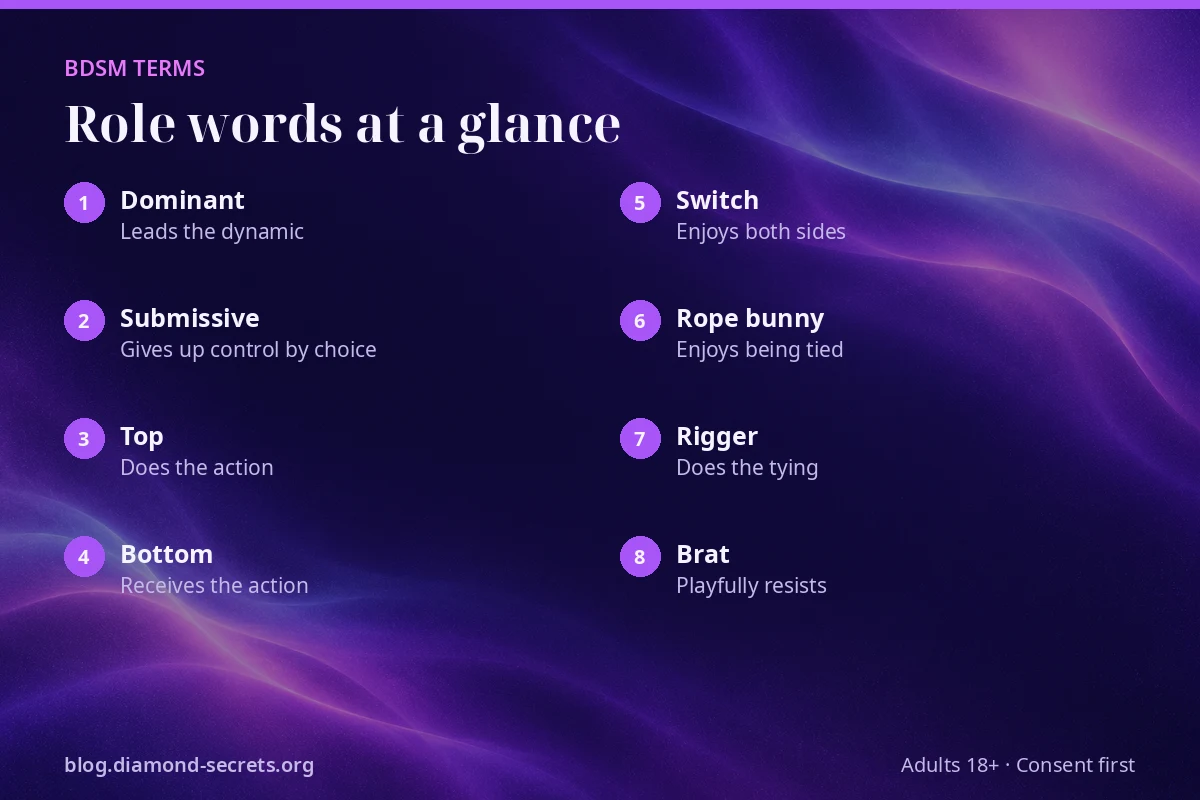
- Dominant (Dom, Domme). The person who takes the lead in a power dynamic, within agreed limits.
- Submissive (sub). The person who gives up some control by choice, within limits they set.
- Top. The person doing the action in a scene, such as tying or spanking.
- Bottom. The person receiving the action. Not always the same as submissive.
- Switch. Someone who enjoys both roles, depending on partner or mood.
- Sadist. Someone who enjoys giving consensual pain or intense sensation.
- Masochist. Someone who enjoys receiving consensual pain or intense sensation.
- Brat. A submissive who playfully resists or teases, often as part of an agreed game.
- Rigger and rope bunny. The person who ties, and the person who enjoys being tied, in rope bondage.
BDSM Terms for Safety and Consent
- Consent. A freely given, informed, specific, and reversible yes. The foundation of everything else.
- Negotiation. The conversation before play about activities, limits, signals, and aftercare. See our BDSM negotiation guide.
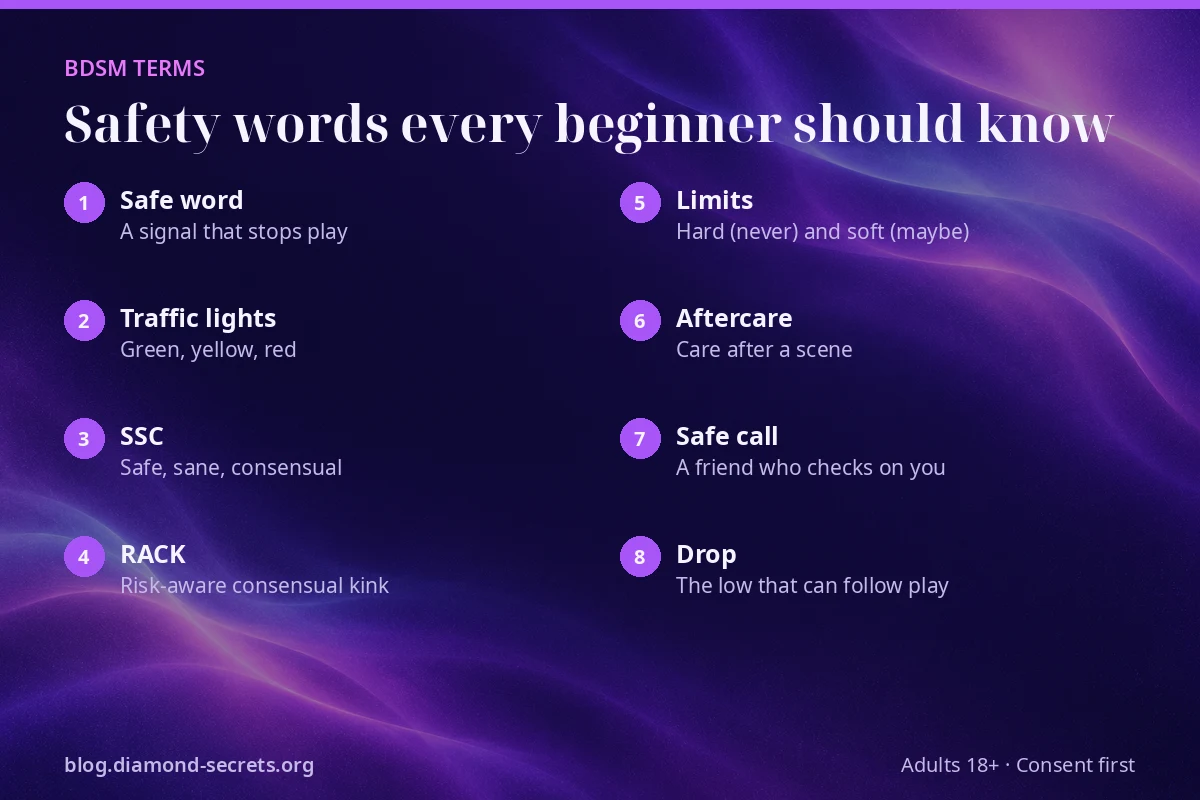
- Safe word. A word or signal that stops or slows play immediately. Read our safe words guide.
- Traffic light system. Green means go, yellow means slow down, red means stop.
- Hard limit. Something you will never do.
- Soft limit. Something you might do under specific conditions. Learn more about hard and soft limits.
- SSC. Safe, sane, and consensual. An early framework for ethical kink.
- RACK. Risk-aware consensual kink. Acknowledges that no activity is risk-free and asks everyone to understand the risks they accept.
- Safe call. Arranging for a trusted friend to check on you at a set time when meeting someone new.
- Aftercare. The care partners give each other after a scene. See our BDSM aftercare guide.
BDSM Terms for Activities
- Scene. A planned period of kink play with a clear beginning and end.
- Play. Any kink activity. People “play” together or “do a scene.”
- Bondage. Restraint using rope, cuffs, or other tools. Always keep safety shears nearby.
- Impact play. Spanking, paddling, or flogging, focused on safe, padded areas of the body.
- Sensation play. Exploring textures, temperatures, and touch, such as feathers or ice.
- Roleplay. Taking on characters or scenarios, such as teacher and student or captor and captive, with agreed limits.
- Protocol. Agreed rules of behavior, such as forms of address, within a dynamic.
- Power exchange. An agreed shift of authority from one partner to another. Our power exchange guide explains the different types.
BDSM Terms for Feelings and Headspace
- Subspace. A floaty, euphoric state some submissives enter during a scene. Judgment can be impaired, so negotiation must happen beforehand.
- Topspace or domspace. A focused, energized state the top or dominant may experience.
- Sub drop. The emotional low that can follow intense play. See our guide to sub drop.
- Dom drop. The same kind of low, experienced by the dominant or top.
- Edge play. Activities with higher physical or emotional risk. Not for beginners, and some carry risks no amount of skill can remove.
BDSM Terms for Community
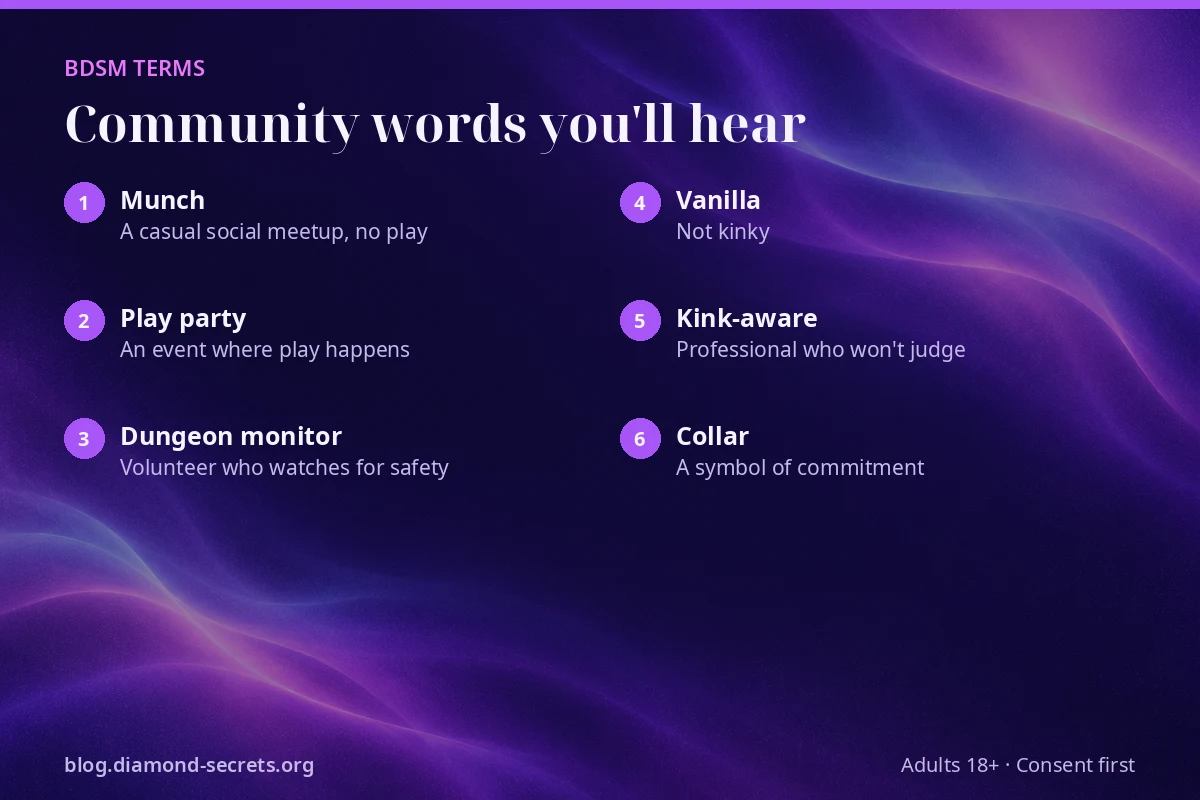
- Vanilla. Non-kinky sex or people. Not an insult, just a description.
- Munch. A casual social meetup, usually at a restaurant or cafe, with no play involved. A great first step into local community.
- Play party. An event where kink play happens, usually with house rules.
- Dungeon. A space equipped for kink play, at a club or private home.
- Dungeon monitor (DM). A volunteer who watches play at an event and steps in if safety rules are broken.
- Collar. In a D/s relationship, a symbol of commitment, roughly like a ring. Meanings vary widely.
- Kink-aware professional. A doctor, therapist, or lawyer who will not judge kink. The National Coalition for Sexual Freedom lists resources for finding one.
How to Use BDSM Terms in Conversation
Knowing the words is one thing. Using them well is another. A few tips:
- Ask, do not assume. “When you say brat, what does that look like for you?” saves a lot of confusion.
- Use them in your profile. A short line like “switch, new to kink, loves sensation play, hard limits on photos” helps the right people find you.
- Do not let labels box you in. BDSM terms describe; they do not prescribe. You can enjoy something without adopting a label for it.
- Watch for misuse. If someone uses BDSM terms to pressure you, such as “a good sub would do this,” treat it as a warning sign. Our guide to BDSM red flags explains more.
BDSM Terms in Online Chat
Text spaces have a few extra terms of their own. OOC means “out of character,” used to step outside a roleplay. IC means “in character.” Double parentheses, like ((brb)), often mark out-of-character messages. Many players mention their limits and preferred BDSM terms in their profile so partners know the basics before saying hello.
Our BDSM chat etiquette guide covers online norms in more depth, and our moderated BDSM room is a friendly place to practice. If you are new to roleplay in general, try the roleplay room too.
BDSM Terms People Often Get Wrong
Some BDSM terms are commonly misunderstood, even by people who have been around for a while. Clearing them up prevents confusing conversations:
- Top versus dominant. A top performs the action; a dominant holds authority. You can be a submissive who tops, for example by tying a partner because your dominant told you to.
- Bottom versus submissive. A bottom receives the action, but may not be giving up any authority at all. Some bottoms direct the whole scene.
- Brat versus disrespect. Bratting is an agreed, playful game. Ignoring real limits or genuinely insulting a partner is not bratting.
- Subspace versus consent. Someone in subspace may not be able to make clear decisions. That is why negotiation happens before play, never during it.
- Collar versus ownership. A collar can be a meaningful symbol, but it never removes someone’s right to say no or leave.
Learning More BDSM Terms Safely
Forty BDSM terms is a solid start, but you will hear plenty more. When you come across a new one, look for sources written by kink educators, community organizations, or experienced members of moderated spaces. Be cautious about learning from porn or fiction, which often skip consent, safety, and aftercare entirely.
And when in doubt, ask. Experienced kinksters are usually happy to explain BDSM terms to someone who is curious and respectful. Asking questions shows you care about getting things right, which is exactly the attitude good partners look for.
A Short Practice Exercise
Try writing a three-line description of yourself using the BDSM terms above. For example: “New to kink and probably a switch. Curious about sensation play and light bondage. Hard limits: photos and name-calling; I love the traffic light system and need cuddly aftercare.” Reading it back helps you see what you want, and it makes the next conversation with a partner much easier.
Frequently Asked Questions
Do I need to know all these BDSM terms before I start?
No. Learn the safety and consent words first: consent, negotiation, safe word, limits, and aftercare. The rest will come with time.
Why do different people define BDSM terms differently?
Kink communities grew up in many places at once, and language evolves. That is why asking a partner what a word means to them is always a good idea.
Is “vanilla” an insult?
Not usually. It simply means non-kinky. Plenty of people enjoy both vanilla and kinky experiences.
Keep Learning
These 40 BDSM terms will carry you through most beginner conversations. The more fluent you get, the easier it is to explain what you want, understand others, and recognize when someone is not playing fair.
Ready for the next step? Read our BDSM for beginners guide, then come put your new vocabulary to use in our BDSM chat room.

PhoenixJenn (aka Symphony) is the founder of Diamond Secrets — the 18+ chat community she built from scratch because the internet needed a place that actually felt worth staying in. Part platform builder, part community guardian, part music obsessive, she handles everything from tech and design to cyber safety and community culture, which means no two days look the same.
She’s been building online communities for years and genuinely cares about getting it right — which is why Diamond Secrets keeps growing while other chat sites quietly fade away. Safety is baked in from the start here, not bolted on as an afterthought, and the warm atmosphere isn’t an accident either. That’s all her.
If Diamond Secrets feels like a hidden gem worth telling your friends about, that’s entirely on purpose.